Skip to content

Ever been in the middle of homework time when your child suddenly asks, “Mum, what’s an adverb?” or “Dad, is ‘swimming’ a verb or a noun?”
And for a split second, you freeze.
If that sounds familiar, you’re definitely not alone. In today’s fast-moving, screen-heavy world, children type messages faster than they think them through. Emojis replace sentences. Voice notes replace clarity. And somewhere in between, the ability to express thoughts clearly starts slipping away.
That’s why grammar still matters.
Not in the old-school, red-pen way. But it is a real-life skill that helps children think more clearly, speak more clearly, and write with confidence. A strong foundation in language supports exam success, yes. But more importantly, it shapes how children organise thoughts, ask questions, and communicate ideas without hesitation.
At Witty Schools, we believe grammar should feel relevant, engaging, and rooted in everyday life. This guide is not a textbook lecture. Think of it as a friendly conversation that helps you support your child without feeling like you need a refresher course yourself.
What are parts of speech?
Let’s make this simple.
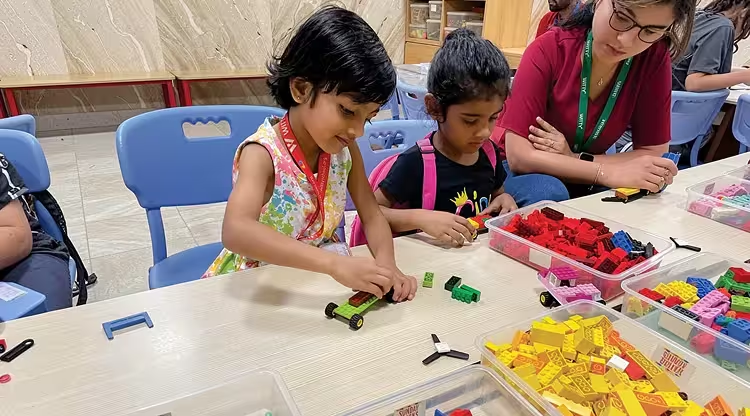
Imagine your child is building something with Lego. There are base blocks, connecting pieces, decorative parts, and special pieces that bring everything together. Language works the same way.
Every word in English has a role to play. That role is what we call parts of speech.
Some words name things. Some show action. Some describe. Some connect ideas. When children understand these roles, language stops feeling random and starts making sense.
This is essentially what parts of speech are in grammar. It is not about memorising labels just to pass exams. It is about understanding how sentences are built so children can create, fix, and improve their own writing. Think of it as the instruction manual for clear communication.
Why This “Boring” Topic Is Actually Your Child’s Secret Weapon
Let’s be honest. Grammar does not sound exciting at first.
But here’s the truth. When children understand how language works, they gain control over it.
- They write stronger stories.
- They argue their point better in debates.
- They explain their doubts clearly in class.
- They express their opinions with confidence rather than hesitation.
This is where why parts of speech are important really comes into play. Clarity builds confidence. A child who can frame a clear sentence can also frame a clear thought. That skill goes far beyond English exams. It shows up in interviews, presentations, and everyday conversations.
At Witty Schools, this is exactly what we focus on. Preparing students not just to score well, but to communicate well in real life.
The Guide to the Eight Parts of Speech: Let’s Get Familiar
Forget rote memorisation. Let’s anchor each category in our daily life. Picture your own home, your family conversations, and the street outside your window.
1. Nouns (The Namers): These are the ‘who’ and the ‘what’. Every person, place, thing, or idea you can name.
- Common Nouns (Everyday Items): Think of the rickshaw outside, the market where you buy veggies, and the festival of Diwali with its lights.
- Proper Nouns (Specific, Capitalised Names): This is Priya from next door, your holiday in Udaipur, or your child’s school, Witty Schools.
- Abstract Nouns (Feelings & Ideas): The happiness (khushi) from a family meal, the bravery (bahaduri) in a story, the tradition of Sunday cricket.
2. Pronouns (The Smooth Operators): They prevent clumsy repetition. Instead of saying “Grandma said Grandma would make Grandma’s special halwa,” we say “Grandma said she would make her special halwa.” He, she, they, we – these tiny words make conversations flow naturally.
3. Verbs (The Energy Burst): The heartbeat of every sentence. They show all action and state of being.
Action Verbs: Your child studies, plays cricket, and helps in the kitchen. The dog barks.
Being/Linking Verbs: They connect the subject to more information. “I am home.” “This halwa tastes amazing.” “She seems happy.”
4. Adjectives (The Flavour Makers): They describe nouns, adding spice and colour. Was the samosa just good, or was it a crispy, golden, spicy samosa? Is the new teacher knowledgeable and approachable? Adjectives turn a basic sketch into a vivid painting.
5.Adverbs (The Detail Experts): These versatile words modify verbs, adjectives, or even other adverbs. They answer the key questions: How? When? Where? To what degree?
- How? She solved the puzzle quickly. He spoke politely.
- When? We will leave soon. Finish your homework first.
- Where? Place the book here. Look everywhere.
- To what degree? The movie was incredibly exciting. She is almost ready.
6. Prepositions (The Relationship Guides): They show how nouns/pronouns relate to everything else in time, space, or direction. The keys are on the table. We gather around the TV. Dinner is at 8 PM. They are the GPS of a sentence.
7. Conjunctions (The Master Connectors): The joiners that build complex thoughts. And adds, but contrasts, because it gives reason, although it shows concession. “I wanted to play outside because the weather was nice, but my project was due.” They teach logical flow.
8. Interjections (The Emotion Sparks): Quick, often standalone bursts of feeling! Wow! Arrey! Oh dear! Shabash! They are the high-fives and facepalms of language, making it real and relatable.
Making it Stick: Practical, Playful Tips for Your Family
Learning thrives on connection, not pressure. Here’s how to weave this into daily life.
1. Become ‘Word Detectives’ During Downtime: Turn passive moments into games. While watching their favourite cartoon or a cricket match, ask, “Can you spot three action verbs from that last over?” or “What’s a strong adjective to describe that character’s expression?”
2. Connect to Daily Routines: Use your home as a classroom. “The washing machine (noun) is spinning noisily (adverb) in (preposition) the utility room.” Talk about the efficient (adjective) way they packed their bag.
3. Embrace Tech-Savvy Practice: Use educational apps and online quizzes that turn grammar into a game. Short, five-minute challenges can be more effective than an hour of grumpy drilling.
4. Read Aloud and Analyse Joyfully: When reading a bedtime story or a news article together, pause at a beautiful or powerful sentence. Ask, “What makes this sentence so effective? Is it the descriptive adjective or the strong verb?” This builds an intuitive appreciation for good writing.
5. Celebrate the ‘Desi’ Context: Encourage them to create examples from their own world. A proper noun isn’t just ‘London’; it’s Lake Pichola. An abstract noun isn’t just ‘beauty’; it’s the serenity of a Rajasthani fort at sunset.
How Witty Schools Build Confident Communicators
We understand that for parents evaluating the top CBSE schools in Rajasthan, the decision hinges on more than infrastructure. It’s about methodology. At Witty Schools, our ICSE and IGCSE frameworks are delivered by educators who make grammar tangible. We move beyond the page, using debates, creative writing workshops, and digital storytelling projects where these parts of speech become active tools for creation.
Our environment encourages students from Udaipur to Mumbai to frame examples in their own cultural context, validating their lived experience while mastering a global language.
For families seeking a holistic launchpad, we are committed to being more than a school listed among the top schools in Udaipur, Rajasthan; we are a learning ecosystem that prioritises articulate, confident, and expressive individuals.
The Final Word: Your Partner in Parenting
Understanding parts of speech in English is a journey you and your child take together. It’s about empowering them with the clarity to ask questions, the precision to share ideas, and the confidence to own their voice. This isn’t a small thing. It’s a foundational life skill.
We believe in partnering with parents like you who see education as a holistic journey. If you envision a learning environment where grammar is a gateway to confidence, not a chore, we invite you to see the Witty difference.
Let’s build your child’s foundation for eloquent expression together. Discover our child-centric approach and modern campus by visiting Witty Schools to schedule a personal conversation today.