Skip to content

Key Takeaways
- Technology works best when it serves a clear learning goal and a good teacher.
- The main risks are distraction, screen time, privacy and unequal access.
- Digital tools should sit alongside discussion, handwriting, experiments, sport and art.
- Parents should ask any school how it uses technology and supports children without devices.
- At Witty, tech-enabled classrooms and a robotics and innovation lab work alongside yoga, music, dance and sport.
Does technology help or hinder the educational process? Honestly, it can be either. The pros and cons of technology in education depend on how it is applied. At Witty International School, we use it to improve the educational process and support teaching, but never to replace it.
What Are the Advantages of Technology in Education?
The advantages of technology in education are:
- Information access: Digital texts, video materials and simulations are available in each classroom.
- Interactive learning: Screens, polls, and demonstrations make classes more engaging.
- Flexible revision: Students can come back to the topic and practice again.
- Teamwork: Through shared documents, students can collaborate.
- Digital skills: Learning to use the internet helps students filter information.
- Fast results: tests inform teachers about whom to help.
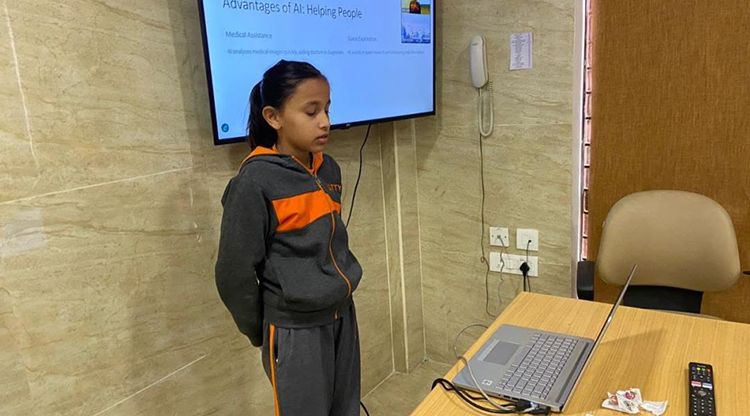
We demonstrate this fact with evidence. Our Malad campus includes hi-tech classrooms, science labs, computer labs, and robotics and engineering labs. Robotics and ICT are on the Cambridge syllabus from Grade 1.
How Does Technology Support Engagement and Personalised Learning?
Tools do not themselves foster engagement. The questions the teacher proposes and the responses that follow engage.
- Interactive boards help illustrate the theory by showing diagrams and examples.
- Simulations let students learn about processes that are difficult to witness firsthand.
- Collaborative workspaces support teamwork in planning and presenting ideas.
Consider a Grade 6 learner struggling with fractions. She looks for a brief explanation, and the teacher checks whether each student understands. This is where our class size plays a role. We mention an ideal ratio of 1:15 at the preschool level and 1:30 in all grades after that and at AS and A level.
What Are the Challenges of Technology in the Classroom?
- Distraction: Messaging tools and games compete with learning materials.
- Cost and maintenance: Devices require fixing, updating, and training of teachers.
- Privacy: Schools must ensure approved programs are used, and students’ data is protected.
- Over-dependence: Technologies cannot substitute good teaching.
Here are the 12 advantages and disadvantages of technology in education at a glance:
| Advantages | Disadvantages |
| Wider access to resources | Distraction from lessons |
| Higher engagement | Excess screen time |
| Flexible pace | Uneven access to devices |
| Easier collaboration | Cost and maintenance |
| Digital skill building | Privacy and data risks |
| Faster feedback | Over-reliance on tools |
Weighing the advantages and disadvantages of technology in education is the first step.
How Much Screen Time Is Too Much?
PRAGYATA are guidelines on online education released in 2020 by the Ministry of Human Resource Development and were in effect at the time. These guidelines are advisory; they address e-learning sessions rather than technology use in schools.
| Stage | Recommended online learning |
| Pre-primary | Not more than 30 minutes a day |
| Classes 1 to 8 | Up to two sessions of 30 to 45 minutes |
| Classes 9 to 12 | Up to four sessions of 30 to 45 minutes |
Children need an hour for play, socialising, and physical activity. Through grades 1 to 8, Witty’s timetable provides for yoga, dancing, music, physical education, art and craft, library, and speech and drama. The campus includes a football pitch, skating rink, and indoor sports facility.
Where Does the Digital Divide Show Up?
The issue of equitable access persists. UDISE+ 2024-25 from the Ministry of Education indicates that 63.5% of schools in India had internet access, up from 53.9% a year earlier. Computer access reached 64.7% (PIB). This means more than a third of schools still lack an internet connection.
Even if a school has connectivity, children may not have access to a device at home. Thus, ask each school how it supports students in this regard. Our library, reading lounge, and laboratories enable students to work online in shared spaces.
How Can We Balance Traditional Teaching with Technology?
| Method | What it builds | How technology helps |
| Discussion | Speaking and listening | Polls give quieter students a voice |
| Handwriting | Organising ideas | Digital notes make revision easier |
| Experiments | Direct observation | Simulations show what labs cannot |
| Print reading | Focus without a screen | Digital texts widen access |
What Can Teachers and Parents Do?
Use the right technology for the lesson’s aim, and make sure your child knows how to use it. Parents can:
- Set ‘tech-free’ times (e.g. during meals and bedtime)
- Ask your child to demonstrate their learning
- Ensure there is a good balance between screen time and play or reading or discussion.
Frequently Asked Questions
1. What are the advantages of technology in the field of education?
Greater access to information, interactive courses, teamwork, and timely feedback under the supervision of an educator.
2. What are the disadvantages?
Distraction, time spent with electronic devices, security issues, inequity of access and expense.
3. How must educational institutions combine traditional and technological approaches to the teaching process?
Information technologies should be limited to specific tasks, while leaving enough time for discussion, handwriting, experiments, sports, and art.
Conclusion
Technology helps most when it has a clear purpose and a strong teacher behind it. Ask us how we choose tools and protect student data. We are happy to show you.
Explore the top schools in Mumbai with us, or visit Witty Kids, among the international schools in Goregaon, where tech-enabled classrooms and a reading lounge support our youngest learners. Read about our admission procedure in schools, then book a campus tour.