Skip to content

How to Develop Critical Thinking and Inquiry Skills in Your Child
Dear parents,
Imagine your child scrolling through YouTube and stumbling upon an ad that shouts, “Speak English fluently in just 10 days!” Most kids would be tempted to click “Buy now”. But your child pauses and thinks:
- Can anyone really learn a language in just 10 days?
- Who is making this promise?
- What do they get if I believe it?
That tiny pause is not just hesitation — it’s critical thinking in action. It’s the difference between blindly accepting information and thoughtfully questioning it.
At Witty Schools, we believe that teaching children how to think is just as important as teaching them what to learn. That’s why this blog is designed especially for Indian parents who want to build strong critical thinking and inquiry skills at home — using simple daily conversations, everyday situations, and real-life examples your child can relate to.
By the end of this blog, you’ll know exactly how to develop critical thinking in your child step by step, so you can raise a curious, confident thinker right from your living room.
Why it matters today
In our age of WhatsApp forwards and infinite videos, children are bombarded with information. They need more than recall; they need reasoning. Consider:
- A 2024 article noted that digital-age children must learn to ask “Is this true?”, “Who is behind this?” and “Why should I care?” as part of their thinking process.
- In India, research shows that although many students finish school, fewer than 20% of engineering graduates are truly job-ready because they lack analytical and reasoning skills.
- The latest policy in India emphasises teaching how to think rather than what to think.
If your child develops strong inquiry skills now, they will be more confident, curious, and ready for a future that keeps changing.
Practical ways you and your child can grow thinking skills
Here are tested and culturally relevant methods you can use to develop critical thinking skills:
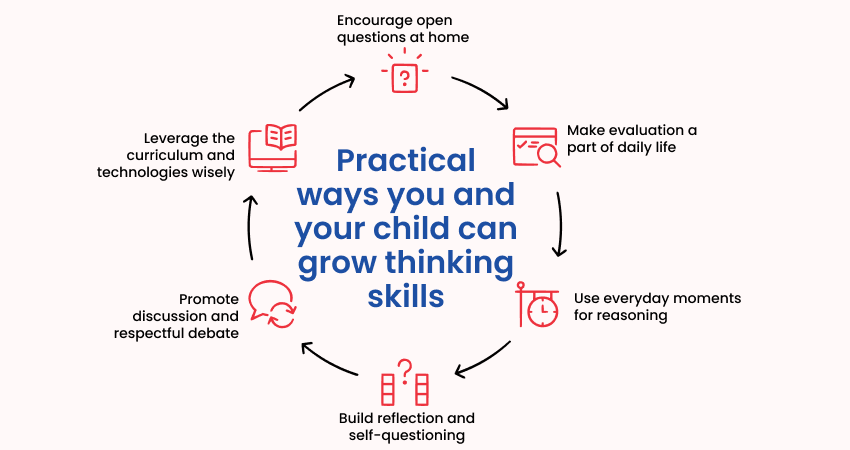
- Encourage open questions at home
- Make a habit of asking, “Why do you think this happened?”, “What if we change this?”, and “How would you do it differently?”
- At lunch, turn a common topic such as family tradition or festival into a question: “Why do we celebrate this in this way? Could we change one thing and see what happens?” That kind of brief conversation will help them develop their inquiry skills.
- Celebrate when they say, “I don’t know. Let me check,” because that reflects curiosity.
- Make evaluation a part of daily life
- While watching news clips or seeing posts on social media, ask, “Who posted this?”, “Do I trust this website?”, “Where is the proof?”
- When your child uses an app that claims “instant learning”, pause and ask together, “Is the promise realistic?”
- Studies show that children who practise evaluating information online develop stronger reasoning skills.
- Use everyday moments for reasoning
- When you shop, involve your child in comparing two products: “This one is cheaper. Why might that be? Is the material less good? Is the brand less reliable?”
- During a walk in the neighbourhoods, ask, “Why are some shops closed earlier? What might cause this?” Let your child observe and propose ideas.
- Connect their school learning to real life: “You learnt about ecosystems today; the park nearby has many trees. How might that affect birds and insects here?”
- Build reflection and self-questioning
- At the end of the school day, gently ask your child, “What did you understand easily? What puzzled you? What would you do differently tomorrow?”
- Encourage them to keep a short diary or voice note: “One thing I found interesting, one thing I would ask again.”
- This kind of habit builds what educators call meta-thinking, thinking about how we think, which is a deep layer of inquiry.
- Promote discussion and respectful debate
- Create small opportunities for debate: maybe ask your teen to argue for and against a topic (like “Should homework be shorter?”). You swap roles and ask them to argue the opposite.
- At home, group work can be fun: siblings or friends can team up to solve a puzzle or design a simple project and then present their reasoning to each other. At Witty Schools, we integrate collaborative tasks from an early age.
- Encourage listening as well: teach your child that hearing someone else’s view doesn’t weaken their own thinking. It strengthens it.
- Leverage the curriculum and technologies wisely
- Whether your child is preparing for nursery school admission or is already in senior grades, ensure that their learning environment supports enquiry-based methods. At your home, you can reinforce it.
- Use apps and interactive games that challenge reasoning rather than mere drill. For instance, a logic puzzle or simulation game helps thinking more than rote repetition.
- Blend screen time with discussion: after watching a video, ask, “What did you like? What surprised you? What questions would you have asked the makers?”
Adapt to the Indian context and values
- Use familiar Indian examples and stories: ask, “What if Ashoka had made a different decision after the Kalinga war? How might India’s history change?”
- Use family culture: “For Diwali, we light diyas and burst firecrackers. Why do we do that? Could there be a new way to celebrate and still keep the values?”
- Tap into local places: for example, in Mumbai, you might visit a locality with street vendors and ask your child, “How do they decide the price? Why do some pay more than others? What if they changed their strategy?” That kind of real-life enquiry builds thinking in a culturally rooted way.
Conclusion
You now have concrete ways to practise how to improve critical thinking in your child. These small, daily conversations and tasks help turn curiosity into a habit. As your child develops these inquiry skills, they will grow into resilient learners equipped for our changing world.
Ready to explore how a school like Witty Schools, one of the best international schools in Borivali, can support this journey? Reach out to schedule a campus visit or talk with our faculty about how critical thinking is a core part of our learning culture.