The finding that 83.3% of educators saw both positive and negative consequences capture something important: we rarely deal in pure goods or pure harms. We deal in trade-offs. Educators flagged consistent worries: addiction to social media, loss of face-to-face communication, early exposure to inappropriate content, sedentary lifestyles, and erosion of moral values and family life.
Can Technology and Childhood Innocence Co-exist Meaningfully?
Yes, but only if we are deliberate about it. Technology in early childhood education holds genuine promise. Interactive storytelling tools, creative coding apps, and digital drawing platforms can light up a young mind in ways a textbook alone cannot reach. The concern lies in the tool itself and more in the absence of guided, age-appropriate use.
One striking finding: 96.7% of educators agreed that high-tech devices such as smartwatches and mini cameras have become a source of cheating in exams. When technology outpaces the ethical frameworks we build around it, everyone suffers, especially children.
Privacy is another area where childhood and technology collide. 66.7% of educators believe technology has reduced privacy. Every time we hand a child a connected device, we place them in a world where their data and choices leave a trail, and most children and many parents do not know that.
Key Findings from the Educator Survey
| Research Question / Finding | % of Educators |
| Technology improved communication | 96.7% |
| Technology essential to modern community | 93.3% |
| Technology fosters innovation | 86.7% |
| Technology: both positive & negative impact | 83.3% |
| Technology made communities more connected | 66.7% |
| Technology reduced privacy | 66.7% |
| Technology replacing jobs | 66.7% |
| Technology made people more productive | 60.0% |
| Technology decreased social inequality | 53.3% |
Are Schools Getting the Balance Right?
What NEP 2020 and Parents Both Need
NEP 2020 pushes hard for digital literacy, reduced rote learning, and experiential education. The fact that students search for answers online before attempting maps directly to what NEP 2020 aims to fix.
CBSE schools implementing NEP 2020 are building classrooms where curiosity and critical thinking sit beside responsible tech use. Witty International School Udaipur offers both CBSE and Cambridge (IGCSE/CIE) curricula aligned with NEP 2020’s vision, while Witty International School Bhilwara follows the CBSE curriculum. And because technology makes global learning accessible regardless of geography, students in both Udaipur and Bhilwara can benefit from internationally influenced teaching approaches, digital learning tools, and future-ready education frameworks.
When parents evaluate schools, the checklist should include the following: Is digital literacy a real subject? Is there a responsible-use policy? How are teachers trained? These questions matter as much as fees or admissions policies.
Which Schools Are Actually Getting the Tech Infrastructure Right?
This is a question every parent asks, and rightly so. The educator survey found that 63.3% of teachers regularly use smart TVs in classrooms, 83% use laptops, and smartboards have become standard in progressive schools. But infrastructure is not just hardware. It is the thinking behind how that hardware is used.
- At Witty International School, Mumbai (with campuses in Borivali and Malad), students learn through state-of-the-art digital classrooms, AR and VR-based learning, robotics labs, and a Learning Management System (LMS) that keeps parents in the loop on every student’s progress. The ICSE and Cambridge (IGCSE) curriculum options ensure students are benchmarked against international standards, not just local ones.
- At Witty International School, Udaipur, the school offers the CBSE and Cambridge (IGCSE) curricula under one roof, which is rare even for city schools. Think about what that means for a student in Rajasthan: access to internationally benchmarked content, taught with smart-tech tools, in a nurturing campus environment. This is exactly the “child in Rajasthan accessing a masterclass from Mumbai” scenario, made real and made local.
- At Witty International School, Bhilwara, Bhilwara’s premier CBSE co-educational school, students benefit from a dynamic blend of innovation, academic excellence, and strong values. The campus focuses on confidence, creativity, and leadership, using technology as a tool for those goals rather than an end in itself.
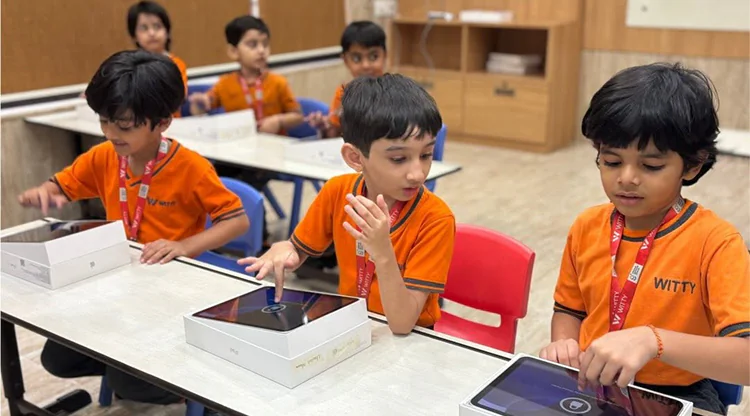
Witty integrates technology into early learning in a simple and structured way, making sure it supports children’s development rather than overwhelming them. Parents who want to explore this further can read how our innovative teaching methods bring technology and human development together.
What Can Parents and Teachers Do Differently?
The educators in this study were consistent: the answer is not avoidance. It is awareness and intention. For parents at home and teachers in classrooms, here is what works:
- Set clear screen time limits, especially for younger children, and keep them.
- Promote hands-on, offline activities alongside digital tools.
- Build genuine digital literacy. Teach students to question what they find online, not just consume it.
- Keep conversations between parents and schools honest and regular, not only at crisis points.
- Model good habits. Children watch what adults do far more than they hear what adults say.
When it comes to teaching technology responsibly, the goal is not to produce faster searchers. It is to build thinkers. And responsible technology in early childhood education sets the tone for a lifetime of mindful digital engagement. See how Witty approaches technology in modern classrooms.
“Technology must not snatch sensitivity and empathy from its users; otherwise, it will change us into robots without emotions. Technology must make lives better.” — Educator respondent
The Smartest Thing We Can Do? Use Technology Wisely
Our children will grow up in a world shaped by technology. That is simply true. But growing up with technology is not the same as growing up because of it.
The research from Udaipur gave us something rare: honest data from the people closest to the question. Educators who use technology themselves, who see its benefits and costs every day, and who are clear-eyed about both. 86.7% said technology fosters innovation. 83.3% said it brings both positive and negative consequences. And nearly all of them came back to the same idea: the key is awareness. Not fear. Not bans. Not blind adoption. Awareness.
Our goal is not to raise children who are faster or more connected than the generation before them. The goal is to raise thoughtful, curious, empathetic human beings who use technology as a tool, rather than being quietly shaped by it without ever noticing.
That is the conversation worth having, in every staffroom, every home, and every classroom where a smartboard hums at the front of the room. At Witty Schools, that conversation never stops.
Frequently Asked Questions
How does the impact of technology on education differ by age group?
For younger children, technology in early childhood education needs to be supervised, purposeful, and balanced with physical play. Passive screen time offers little developmental value.
For older students, technology becomes a research and creative tool but still requires ethical framing. At Witty Schools’ Early Years programme, every digital activity is intentionally scaffolded to match developmental readiness.
Is technology in early childhood education safe?
It can be, when content is age-appropriate, time-limited, and supervised. The risk is not the technology itself but the unguided version of it. Young children need adults to help them make sense of what they see. Research also shows negative effects on attention, social development, and emotional regulation. Our campuses follow strict guidelines on screen time and content for all age groups.
How can schools and parents collaborate on responsible tech use?
Schools should be transparent about which tools they use and why. Parents should reinforce boundaries at home and ask questions. Open, ongoing conversations are more effective than blanket bans or blanket endorsements. Build confident, thoughtful digital users.
With 93.3% of educators viewing technology as essential to modern community life, collaboration is not optional.
What does responsible teaching technology look like?
It looks like a classroom where a teacher asks not just what answer a child found but how they found it and why they trust it. It looks like schools where students build, create, and solve problems with technology as a tool, not a crutch. It looks like educators who are digitally literate themselves and talk openly about risks alongside rewards.
 Skip to content