Skip to content


Every parent has one major concern: will my child be ready for whatever the future throws at them? Frankly, that is a very fair concern. With jobs changing every time a new technology hitting the market “ just knowing facts” may not be enough any longer. That is possibly why more parents are gravitating towards a Cambridge curriculum, a system built not just to teach subjects but also encourages the students to think for themselves. Let’s break down what makes it stand out among all the other forms of curriculum and why it is often called future-ready education.
What Is the Cambridge Curriculum?
The Cambridge international curriculum is developed by the Cambridge Assessment International Education, part of the University of Cambridge. It is designed for students 5 to 19 and includes well-known stages like IGCSE and A Levels. Instead of practicing the habit of rote learning, they inculcate in students the practice of understanding, applying, and questioning, what is being taught and not just repeat it blankly.
Why Future-Ready Education Matters Today ?
The world your child will work in does not exist today but it is not very far away. New industries, new tools, new problems. A good Cambridge education does not try to predict the future but rather builds on the analysing skills that will help them in the future.
How the Cambridge Curriculum Develops Lifelong Learners?
Cambridge students are not taught a syllabus just for that particular grade year or for them to forget their concepts the moment they graduate out of school. They are encouraged to keep asking the “why” of things and come up with alternative “what ifs”. This helps them to not just develop a deeper understanding of the topic at hand but also find alternative solutions or application of the concept at hand.
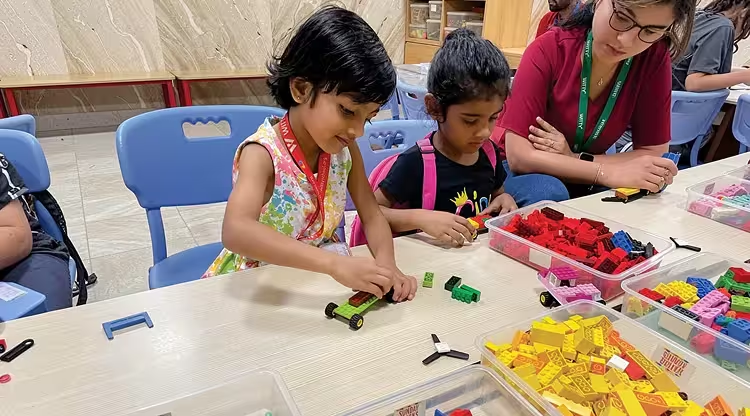
- Building Critical Thinking and Problem-Solving Skills: Lessons are designed in such a way that they open with questions and not an answer. Students explore the topic hands, discuss their understandings and ideas and reason their way to conclusions. This is exactly the kind of approach that is expected by good universities and employers and not a memorised answer sheet.
- Encouraging Creativity and Innovation: Cambridge classrooms provide space for original thinking. Whether it is a science project or a creative essay, students are encouraged to bring their own ideas to the table and not just represent what is written in the textbooks.
- Developing Strong Communication Skills: From arranging debates to presentations to interactive group discussions, students are constantly introduced into an environment where they are given the space to explain their thinking clearly. That is a skill that holds value not just in a board room but in the examination hall today.
- Fostering Independent Learning and Research Abilities: Cambridge students learn to find information, judge its reliability and make use of it well. This habit of working independently helps them greatly when they join a university or workplace.
- Global Perspective and International Recognition: Cambridge qualifications are identified by universities worldwide. This means your school’s graduation certificate broadens their horizon including universities in both India and abroad.
- Preparing Students for Higher Education: By the time students reach the higher levels, they are already prone to thinking independently and coming out with effective alternatives. This makes their transition from school to universities smoother.
- Assessment Methods that Support Continuous Growth: The Cambridge curriculum isn’t just about school-level examinations but includes a carefully constructed system of coursework, practicals and continuous evaluations for a better picture of a student’s growth over time.
- Cambridge Learner Attributes and Their Long-Term Benefits: Cambridge’s perfect students are described as individuals who exhibit attributes of confidence, responsibility, reflective nature, innovation, and engagement. These actually represent the habits which benefit learners not only during their school education.
Why Schools Choose the Cambridge Curriculum?
Schools are choosing in favour of the Cambridge curriculum owing to its balance of academic knowledge and practical education. It is considered a challenging program but it implies more than just learning.
Conclusion
To sum it up, “future-proofing’ isn’t concerned so much with knowing what tomorrow will bring as with creating an individual who would be able to adapt to various circumstances. This is the true power of the Cambridge curriculum.
In case you’re interested in local possibilities, Witty International School in Mumbai offers Cambridge education at its Malad campus as well as two more curriculums – CBSE and ICSE – at different locations across the city. Parents frequently inquire about Cambridge fees in Malad; however, the amounts are not publicly shared, but the admissions team is willing to provide such information if asked. If you’re comparing Cambridge schools in Mumbai more broadly, you should know that the Malad campus implements the complete Cambridge design beginning from Grade 1. Even if you live outside Mumbai, parents looking for schools in Bhilwara may use the chance and explore Witty’s CBSE campus which is a part of the same educational establishment.