Skip to content

Key Takeaways
- Primary education lays the groundwork for reading, reasoning, and focus skills that all other subjects rely upon.
- The manner in which primary education is provided informs the lifelong approach to learning, not only the early years.
- Secondary education takes the groundwork of primary education and moves on to specialism and board examinations.
- The data reveals that in India, as per UDISE+ 2024-25, the retention rate for Class 12 is at a mere 47.2 per cent, as compared to 62.9 per cent for Class 10.
- One of the clearest ways to reduce the risk of dropping out later is to start with a strong foundation in primary education.
Every big building needs a strong foundation, and the education of a child is the same. The early years of schooling quietly set the stage for everything else, including later stages such as secondary education. This guide will discuss why it is so important to give a child a strong educational foundation.
What Is Primary Education and Why Does It Matter?
Primary education generally comprises the early years of formal schooling, Classes 1 to 5. This stage is vital because it develops the skills that a child needs to learn every other subject. At this stage, a child learns to read, write and perform simple arithmetic. They also learn to concentrate and obey in the classroom and learn social skills like sharing.
Lacking any of these skills can make learning later subjects much harder. This is why parents should not underestimate this stage compared with preparing for board examinations.
How Does Primary Education Teaching Shape Learning Habits?
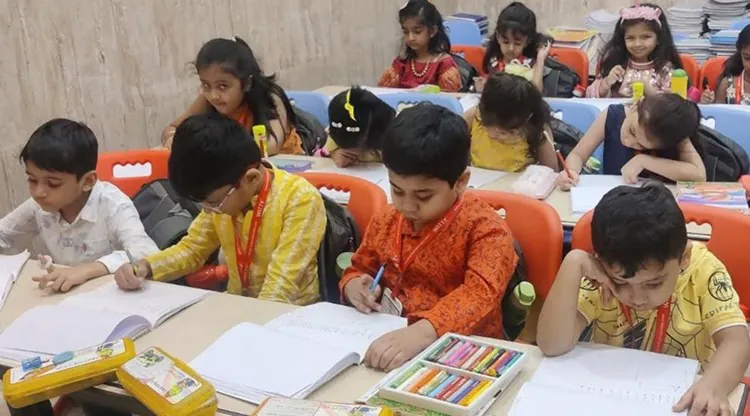
Primary education teaching lays the foundation for a child’s learning. The methodology used at this stage is vital and should try to develop a child’s love of learning. Activity-based learning is better than rote learning for this stage because:
- Activity-based learning is most suitable for young minds.
- It promotes learning through curiosity, whereas rote learning is limited to simply retaining information.
- Learning habits developed at this stage stay with a person throughout their life.
- Confidence developed at this stage can help a child to be confident throughout their educational career.
At this stage, teachers act as facilitators and motivators, guiding a child’s learning process and, hence, shaping how a child approaches learning. Children who develop a liking for learning at this young age are more likely to be better learners as they grow.
What Is Secondary Education and How Is It Different?
Secondary education generally comprises Classes 9 to 12, though the exact stages may differ from board to school. Secondary education is more advanced than primary education since it builds upon the skills learned at the primary stage and requires specialisation, such as choosing between Science, Commerce and Humanities.
Moreover, secondary education involves appearing for and passing the board examination, which is a key deciding factor for further education and career.
This stage is more intense than the earlier stages of education, as it involves making crucial career decisions and requires more serious and independent study habits. However, students who learned to read and reason well at the primary stage and developed good study habits are more likely to be prepared for this challenging stage than those who were not taught accordingly.
What Are the Types of Secondary Schools in India?
While looking for secondary schools for their children, parents may come across several categories of schools depending on the system and syllabus that the school follows. The key types of secondary schools in India are:
| Type of School | Board or System | Best Suited For |
| CBSE Schools | Central Board of Secondary Education | Families wanting a nationally consistent syllabus |
| ICSE Schools | Council for the Indian School Certificate Examinations | Families wanting strong English and detailed subject coverage |
| Cambridge Schools | Cambridge International | Families wanting a globally recognised, skill-based curriculum |
| State Board Schools | State-specific boards | Families wanting regional language support and local relevance |
When choosing a secondary school in Mumbai, children and their parents should consider which type best suits the child’s specific needs and preferences.
How Are Secondary and Higher Secondary Education Connected?
Secondary and higher secondary education together form a fundamental part of a child’s education. Secondary education (Classes 9 to 10) is the foundation upon which the child can specialise further (higher secondary education, Classes 11 to 12) and prepare for the board examinations. In other words, higher secondary education builds on secondary education.
Any child who finds it difficult to cope with Classes 9 or 10 would find it much more difficult to cope with Classes 11 or 12 as these classes are much more intensive. Thus, it is important to be consistent with one’s efforts from an early stage as opposed to preparing specifically for board examinations. This way, the parents can keep an eye on the child’s performance early and take corrective measures if necessary.
How Do Primary Education and Secondary Education Work Together for Success?
Primary education and secondary education are both vital parts of a child’s educational journey and work hand in hand for a smooth learning experience. India’s retention rate in senior secondary education (Class 12) was 47.2 per cent according to the UDISE+ 2024-25 data, compared to 62.9 per cent in secondary education (Class 10). This statistic highlights the importance of primary education, as many students drop out of secondary school because they lack fundamental skills.
The same data highlights that secondary-level dropout is 11.5 per cent, with some states having a higher rate than the national average. Dropping out of school is often a result of poor primary education, which leads to poor comprehension of secondary school subjects. Thus, good primary education with strong reading, reasoning and focus skills is vital to reduce the likelihood of secondary school dropout.
In essence, poor primary education can lead to poor performance in secondary education, and good primary education can lead to good performance in secondary education and beyond.
Why Choose Witty for a Strong Foundation?
Witty International School is focused on building the essential foundation needed for a child’s educational career. In the primary years children learn in a thematic, activity-based way, which helps them build strong literacy, numeracy and reasoning skills.
For families exploring schools in Malad West, Mumbai, Witty’s Malad campus provides an environment where these foundational skills can continue to develop through the primary years.
These skills take a student through middle and secondary schools, which involve significantly increased academic demands. The parents may also want to read about the value of such a solid beginning or how to prepare their child for each stage up to secondary education.
Conclusion
Achievement in secondary education is rarely accidental, as it is built upon a solid foundation of primary education. The development of good reading habits, a confident attitude toward problem-solving, and enhanced concentration skills acquired in early childhood enables a child to approach the more challenging academic experiences of later school years confidently and competently.
For parents considering top schools in Udaipur, Rajasthan, choosing a school that focuses on these foundational skills can help create continuity between early learning and later academic development.
If you want your child to get through secondary education with confidence, enquire at Witty International School to learn how our primary years programme can set your child up for long-term educational success.
FAQs
1. Why is primary education so important for a child’s future?
Primary education matters because it builds the core reading, reasoning, and focus skills needed to succeed in every future subject and stage of education.
2. What is the difference between primary and secondary education?
Primary education refers to the early years of schooling, such as Classes 1 to 5, whereas secondary education comprises Classes 9 to 12 and involves specialising in a stream of study and appearing for the board examinations. The main difference between primary and secondary education is that the latter builds upon the skills and knowledge learned in the former.
3. What are the main types of secondary schools in India?
India has various types of secondary schools based on the system and syllabus that they follow, such as CBSE, ICSE, and Cambridge, among others.
4. How are secondary and higher secondary education linked?
Secondary and higher secondary education are linked because the latter builds on the foundations provided by the former.
5. Does strong primary education affect secondary education?
Yes, strong primary education can significantly impact secondary education. This is evident because many students who struggle with or drop out of secondary education do so because they lack fundamental skills that could have been developed during primary education.