Skip to content

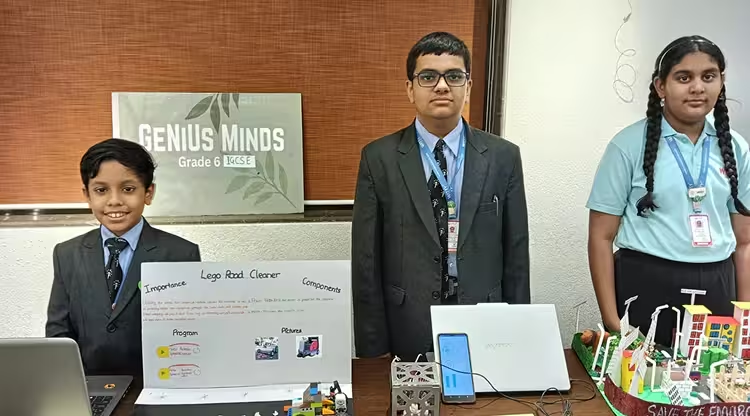
Finding the right school in Mumbai requires more than comparing board results or campus photographs. Parents must assess teaching quality, student support, safety, extracurricular opportunities, affordability and the daily commute.
While the best ICSE schools in Mumbai share a common academic framework, each school delivers it differently. This guide explains how to identify an environment that suits your child’s learning style, interests and long-term development.
Key Takeaways
To choose the right ICSE school in Mumbai, compare its teaching methods, faculty, class size, assessment system, facilities, safety procedures, student support and extracurricular programme. Consider the total fees and travel time during peak hours. Visit shortlisted campuses and observe how confidently students interact with teachers before making your decision.
Why Choose an ICSE School?
ICSE board education can suit children who benefit from broad subject exposure, detailed conceptual learning and regular opportunities to communicate and apply their knowledge.
Its commonly recognised strengths include:
- Strong emphasis on English language and literature
- Detailed coverage of core subjects
- Projects, practical work and internal assessment
- Development of research and presentation skills
- Exposure to languages, sciences and humanities
- Opportunities to build analytical and creative thinking
No curriculum is ideal for every learner. Parents should consider whether its academic depth, language requirements and assessment practices align with their child’s abilities and interests.
Understanding the ICSE Curriculum
The Indian Certificate of Secondary Education is the Class 10 examination conducted by the Council for the Indian School Certificate Examinations. CISCE-affiliated schools prepare students through a broad curriculum that typically includes English, another language, mathematics, science and social studies, alongside additional subjects determined by the school and grade.
The curriculum encourages learners to understand concepts and communicate their reasoning. Projects, experiments, presentations and written assessments may all contribute to learning.
However, affiliation alone does not guarantee quality. The value of the curriculum depends on teacher expertise, classroom implementation, feedback and the support available to students.
Why Choosing the Right School Matters
Two ICSE schools can differ considerably in their learning environments. One may emphasise discussion and experimentation, while another may depend heavily on textbooks and examinations.
A good school should provide appropriate academic challenge without creating unnecessary pressure. It should recognise learning gaps, communicate with families and help children develop confidence alongside subject knowledge.
Parents should therefore judge the complete educational experience—not simply the board name or Grade 10 results.
Key Factors to Consider
Academic Excellence and Teaching Methodology
Ask how teachers explain difficult ideas and whether lessons include projects, discussions, experiments and real-world applications. Effective teaching helps students understand why an answer works rather than memorising it temporarily.
Review recent academic outcomes across several years, but interpret them carefully. Results should be considered alongside student progress, teaching practices and well-being.
Faculty Experience and Student Support
Enquire about teacher qualifications, ICSE experience, professional development and staff turnover. Also ask for the actual class strength rather than relying only on an advertised student-teacher ratio.
Good ICSE schools in Mumbai should have a clear process for identifying and addressing learning gaps. This may include teacher intervention, remedial lessons, counselling and regular conversations with parents.
Assessment and Parent Communication
Find out how frequently students are assessed and how feedback is shared. A balanced approach may combine tests, assignments, projects, practical work and classroom observation.
Parents should receive useful information about strengths, challenges and next steps—not marks alone. Ask how frequently parent-teacher meetings and progress updates occur.
Extracurricular and Holistic Development
Sport, music, art, theatre, clubs, debate and community activities can develop teamwork, creativity and leadership.
Check whether these opportunities are included regularly in the timetable and available to all students. An extensive activity list has limited value when participation is restricted to selected performers.
Safety and Student Well-Being
Inspect entry controls, CCTV coverage, medical facilities, washrooms and emergency procedures. If transport is provided, ask about GPS tracking, attendants, driver verification and route duration.
Emotional safety matters equally. Determine how the school prevents bullying, handles complaints and supports children experiencing academic or personal difficulties.
Location and Daily Commute
Mumbai traffic can significantly affect a child’s day. Test the route during regular school hours and consider the complete door-to-door journey.
A long commute may reduce time for sleep, family interaction, recreation and independent study. Location should not be the only deciding factor, but it deserves serious consideration.
Fees and Admission Transparency
Request a written breakdown covering tuition, admission, transport, books, uniforms, technology and activities. Clarify payment schedules, annual increases and refund conditions.
The admission process should explain eligibility, documents, interaction requirements and timelines clearly.
Common Mistakes to Avoid
Parents should avoid:
- Choosing solely because of rankings or advertising
- Comparing only Grade 10 results
- Ignoring actual class size and teacher accessibility
- Assuming premium facilities guarantee better learning
- Underestimating Mumbai commute times
- Failing to verify all compulsory expenses
- Selecting a school without visiting its campus
- Ignoring their child’s temperament and learning needs
Exploring Witty’s ICSE Education in Mumbai
Families researching ICSE schools in Mumbai can explore Witty’s curriculum and campus options. Parents specifically seeking an ICSE school in Malad can review its academic programme and learning facilities.
Those comparing other pathways may explore Witty’s Cambridge schools in Mumbai. Families searching for international schools in Borivali can also review the relevant campus information and offered grades.
Programme availability, facilities and admission criteria can change by campus and academic year. Parents should confirm current details directly and schedule a campus tour before applying.
Conclusion
The right ICSE school should challenge children academically while helping them feel safe, understood and motivated. Compare teaching, faculty, activities, support, fees and travel demands using consistent criteria.
A thoughtful shortlist and well-planned campus visits will help you move beyond reputation and choose a school where your child can learn confidently and grow as a well-rounded individual.
Frequently Asked Questions
Is ICSE suitable for every child?
ICSE may suit children who enjoy languages, detailed learning, projects and broad subject exposure. Individual interests and learning preferences should guide the decision.
What should parents compare between ICSE schools?
Compare teaching quality, class size, faculty stability, assessments, student support, activities, safety, fees, commute and parent communication.
Why is a campus visit important?
It allows parents to observe classroom engagement, facilities, cleanliness, safety and teacher-student interactions that websites cannot fully demonstrate.
Does Witty offer ICSE education in Mumbai?
Witty provides ICSE pathways at relevant Mumbai campuses. Parents should verify current grades, subject options and admission requirements with their preferred campus.