Skip to content


You ask your child a hundred times to put away their toys, and guess what! Minutes later, the toys are still proudly on display across the living room floor. Sound familiar? The truth is, many children hear but don’t always listen—and that small distinction makes a big difference. Listening isn’t just about following instructions; it’s the cornerstone of learning, communication, and building confidence. A study on Academic Listening Skills in the Indian Context shows that children who practise active listening perform better in school, connect more deeply with others, and develop stronger problem-solving skills. The best part? Listening is not an inborn talent—it’s a skill you can nurture every day with simple, consistent practices. In this blog, we’ll explore 10 effective and practical ways to strengthen your child’s listening skills and set them up for success in every area of life.
What is Active Listening and Why is it Important for Kids?
Active listening is much more than being silent while someone speaks. It is about paying attention, processing what is said, and responding in a thoughtful way. When children practise active listening, they not only absorb information better but also learn empathy, patience, and respect for others.
Why are listening skills important for your child?
A good listener is able to follow instructions at school, understand the emotions of friends, and express themselves with clarity. Active listeners often do better in academics because they catch details in classroom discussions that others may miss. They also grow into better problem-solvers because they take time to truly understand situations before reacting.
10 Practical Strategies to Help Your Child Become a Better Listener
Here are ten effective and parent-friendly ways to nurture listening. Each method is easy to apply in everyday life and can make a lasting difference.
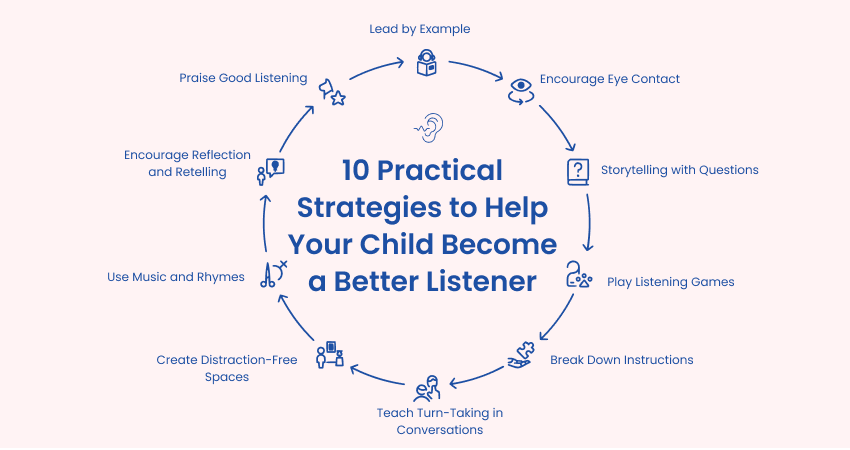
1. Lead by Example
Children learn first by watching their parents. If you stop scrolling on your phone and give them your full attention when they talk, you are modelling how to listen with respect. This sets a standard they will naturally follow. Over time, they learn that communication is not one-sided. If you show that you value their words, they will value yours too. This simple change is one of the most effective ways to improve your listening skills in children.
2. Encourage Eye Contact
Maintaining eye contact is an underrated habit. It keeps your child anchored in the conversation and reduces distractions. You can practise this during meals or bedtime chats. Tell your child that looking at someone while speaking shows care and attention. This is especially helpful in classrooms where eye contact with teachers often helps with better focus and understanding.
3. Storytelling with Questions
Indian families have a long tradition of telling stories, whether it is Panchatantra fables or bedtime tales narrated by grandparents. Use this tradition to strengthen listening. While narrating, pause and ask, “What do you think will happen next?” or “Why do you think the rabbit tricked the lion?” These questions make your child an active participant, helping them process information and build comprehension.
4. Play Listening Games
Games are an exciting way to practise listening without making it feel like work. Classics such as “Simon Says” or “Chinese Whispers” are perfect examples. You can also create a “What’s That Sound?” challenge by asking your child to identify everyday noises like a pressure cooker whistle or birds chirping. These activities train their brain to focus on details and strengthen types of listening skills like discriminative and comprehensive listening.
5. Break Down Instructions
Children often get overwhelmed with long directions. Instead of saying, “Get ready for school quickly,” break it into smaller steps: “Brush your teeth, wear your uniform, and pack your bag.” This makes tasks easier to manage and improves memory. Over time, children learn to process sequential instructions, a skill that is crucial in academic settings.
6. Teach Turn-Taking in Conversations
Waiting for their turn to speak is not always easy for children, but it is a powerful lesson. Practise it at home by holding family discussions where everyone gets time to share before responding. This helps them listen fully before talking. It also builds patience and respect for others, preparing them for group discussions at school and beyond.
7. Create Distraction-Free Spaces
In most Indian homes, televisions, mobile phones, and background noise are constant. Setting aside a few minutes each day as “quiet time” helps children focus better. Whether it is during homework or a family conversation, reducing distractions makes listening more intentional. This small habit can greatly improve how well your child processes what is being said.
8. Use Music and Rhymes
Songs and rhymes are excellent tools to make listening fun. Play an action-based rhyme like “If You’re Happy and You Know It” and ask your child to follow along. This strengthens memory and response skills. Even listening to classical music or bhajans can help children concentrate better, creating calm moments in an otherwise noisy world.
9. Encourage Reflection and Retelling
After watching a cartoon, reading a story, or even attending a family function, ask your child to retell what they experienced. Encourage them to include details, such as who was there or what was said. This builds recall and helps them organise thoughts in a clear manner. Over time, they develop stronger comprehension and critical thinking skills.
10. Praise Good Listening
Children respond positively to encouragement. When your child listens attentively and follows through, acknowledge it with praise. You might say, “I loved how you listened carefully and did exactly what I asked.” Small rewards, such as stickers or an extra ten minutes of play, can reinforce the behaviour. This makes listening feel rewarding and enjoyable.
How Witty Schools Builds Listening Skills Every Day
At Witty Schools, listening is seen as a foundation for lifelong learning. Our classrooms are designed to encourage interaction, whether through storytelling, role plays, or collaborative projects.
Teachers use discussions, debates, and reflection exercises to ensure every child is actively involved. This approach is why we are consistently recognised among good international schools in Mumbai and top schools in Bhilwara. By weaving listening practice into everyday lessons, we ensure that listening skills for students are nurtured alongside academics, creativity, and personal growth.

Help Your Child Get the Witty Advantage
Listening is more than a school skill, it is a life skill. A child who listens well is better prepared for success, both inside and outside the classroom. If you are looking for top schools in Udaipur Rajasthan or admission for kindergarten or higher grades, Witty Schools provides an environment where your child can develop not only strong academics but also essential life skills.
Visit Witty Schools to learn more about how our innovative teaching methods and world-class infrastructure create confident, empathetic, and capable learners.