Skip to content

If you are a parent whose child is about to begin their IGCSE journey, you are probably asking yourself one very important question: which subjects should my child choose? This is a perfectly reasonable concern. The subjects your child selects during their IGCSE years can shape their academic confidence, open or close future career pathways, and directly influence their eligibility for higher education programmes worldwide. Understanding the importance of curriculum choices at this stage truly cannot be overstated.
So, let us walk through this together, step by step.
What Exactly Is the IGCSE Curriculum?
The International General Certificate of Secondary Education (IGCSE) is a globally recognised qualification offered by Cambridge Assessment International Education. Students typically sit for IGCSE examinations at the end of Year 10 or Year 11, generally between the ages of 14 and 16. The curriculum is designed to be broad, balanced, and internationally relevant, making it a popular choice across international schools in Mumbai, across India, and around the world.
Students are usually required to choose between five and ten subjects, selecting from five broad groups: Languages, Humanities and Social Sciences, Sciences, Mathematics, and Creative, Technical, and Vocational subjects. The updated Cambridge IGCSE suite currently offers 38 subjects across these groups.
| Subject Group | Examples |
| Languages | English, French, Hindi, Spanish |
| Humanities & Social Sciences | History, Geography, English Literature |
| Sciences | Biology, Physics, Chemistry |
| Mathematics | Mathematics, Additional Mathematics |
| Creative, Technical & Vocational | Computer Science, Business Studies, Music, Accounting |
Why Does Subject Selection Matter So Much?
The subjects your child chooses at IGCSE level lay the groundwork for their A Levels, International Baccalaureate, or equivalent qualifications. Universities and professional institutions look closely at a student’s subject history when assessing applications. Choosing subjects without a clear sense of your child’s interests or goals can mean unnecessary stress later on.
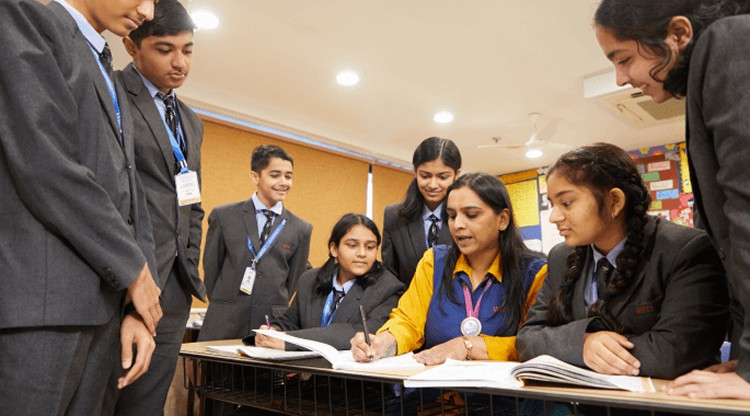
This is why schools often encourage a parent conference before or during the subject selection process. These conversations between families and academic counsellors are invaluable for aligning your child’s strengths with the right subject combination.
How Should You Choose the Right Subjects?
- Start With Your Child’s Interests and Strengths
Ask your child honestly: what subjects do they genuinely enjoy? What comes to them more naturally? A student who loves storytelling and debate may thrive in English Literature and History. One who finds patterns and logic satisfying may lean towards Mathematics and the Sciences. Pushing a child into subjects they dislike rarely ends well.
- Think About Future Career Goals
While it is too early to lock in a specific career at 14, it helps to have a broad direction. Students interested in medicine should prioritise Biology and Chemistry. Those drawn to technology or engineering benefit from Physics and Computer Science. Students considering business or law may want to explore Business Studies, Economics, or a second language.
| Career Interest | Recommended IGCSE Subjects |
| Medicine / Healthcare | Biology, Chemistry, Mathematics |
| Engineering / Technology | Physics, Mathematics, Computer Science |
| Business / Finance | Business Studies, Accounting, Mathematics |
| Law / Social Sciences | History, English Literature, a second Language |
| Arts / Design | Art & Design, English Language, Geography |
- Attend Conferences for Parents and Teachers
Schools regularly arrange conferences for parents specifically to discuss subject choices, student progress, and academic pathways. If your school holds such sessions, attend them. Speak to your child’s current teachers. They know your child’s potential and can offer a perspective that goes beyond what grades alone can tell you.
- Understand Core vs Extended Tiers
Most IGCSE subjects offer two tiers: Core and Extended. The extended tier covers a wider range of content and allows students to achieve higher grades. If your child has demonstrated strong ability in a particular subject, the extended paper is usually recommended. For subjects where they may struggle, the core paper offers a more manageable pathway.
Which Subjects Are Compulsory and Which Are Optional?
Most schools require students to sit for at least one language (usually English) and mathematics. Beyond these compulsory subjects, students typically have flexibility to choose from the remaining groups. The Cambridge ICE (International Certificate of Education) award, for instance, requires students to pass a minimum of seven subjects, including two languages and at least one from each of the remaining four groups.
At Witty Schools, we guide our students through this selection process with the support of experienced academic counsellors, ensuring each child builds a subject combination that suits both their strengths and their aspirations.
When Should Subject Selection Happen?
Subject selection usually takes place at the end of Year 9 or the beginning of Year 10, depending on the school. This gives students and parents time to reflect, consult teachers, and make considered decisions. Schools in Goregaon Mumbai area follow a structured timeline, ensuring families receive all the information they need well in advance.
If your child attends one of the international schools in Mumbai, India, it is worth checking your school’s specific timeline and requesting a parent and teacher meeting early in the process. The earlier you engage, the better prepared your child will be.
What Should Parents Keep in Mind During This Process?
- Do not project your own career preferences onto your child’s choices.
- Balance ambition with realism. Choosing too many demanding subjects at once can lead to burnout.
- Look at the subject as a whole, including coursework components, practical work, and examination format.
- Encourage your child to speak to older students who have already completed the IGCSE.
- Trust the process. A well-chosen set of subjects, studied with genuine interest, produces far better outcomes than a prestigious combination chosen for the wrong reasons.
Frequently Asked Questions (FAQs)
1. How many subjects should my child choose for IGCSE?
Most students take between five and ten subjects. The minimum required to be eligible for the Cambridge ICE award is seven. Many schools recommend around eight or nine subjects to maintain a balanced workload.
2. What happens if my child wants to change a subject after registration?
Subject changes are sometimes possible early in Year 10, but they become increasingly difficult as the academic year progresses. It is always better to raise concerns during the initial selection process rather than after it.
3. Should my child take the hardest possible subjects to impress universities?
Not necessarily. Universities value strong grades in appropriate subjects over poor grades in subjects chosen purely for prestige. A thoughtful, well-matched subject selection is always preferable.
4. Are all IGCSE subjects equally recognised by universities?
Most IGCSE subjects are widely recognised. However, some competitive university programmes may specify prerequisite subjects. It is advisable to research the entry requirements of likely university destinations as part of the subject selection process.