Skip to content


How to Prepare for Exams Without Stressing Over It?
If the thought of your child’s next exam makes you uneasy – perhaps recalling shaky nights, frantic last-minute revision, or anxious mornings – you’re definitely not alone. In fact, around 80% of students in Classes 9-12 in India report anxiety linked to exams and results.
At Witty Schools, we believe that exam time doesn’t have to mean stress for your child or for you. Here’s a fresh approach to how to prepare for exams in a way that supports confidence, understanding and calm.
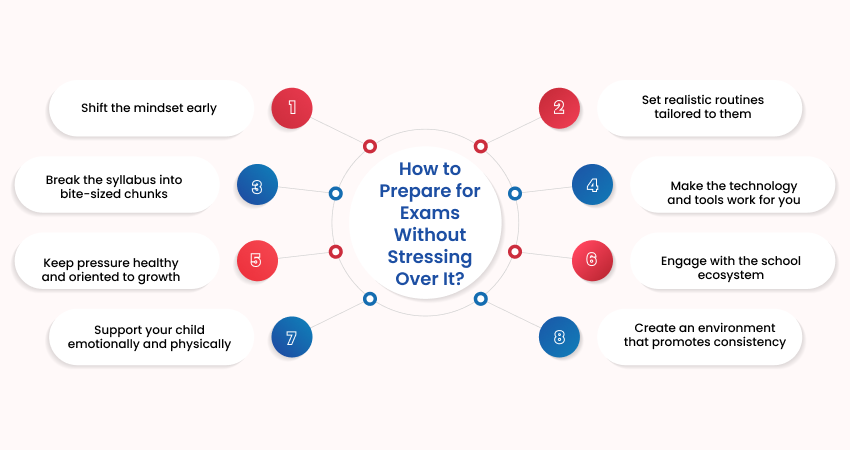
- Shift the mindset early
- Remind your child that exams are a way of showing learning, not a final judgement. A study found that 86 % of adolescents experienced high academic stress and 87 % felt strong parental pressure.
- Create a culture in your home where questions are welcomed and mistakes are viewed as stepping-stones. This works wonders for reducing performance anxiety.
- Encourage short, regular check-in chats: “What did you learn today?” rather than “How many more hours will you study tonight?”
- Set realistic routines tailored to them
- Help your child build a revision schedule that respects their natural rhythms. For example, if they work better in the late afternoon, plan a focused slot then, followed by a light physical break.
- Emphasise sleep, hydration and movement. Research shows exam stress increases cortisol and can impair memory and blood pressure regulation.
- Introduce a “wind-down ritual” after revision. Perhaps a quick family walk or an unplugged half-hour with a book. This acts as a reset button for the brain.
- Break the syllabus into bite-sized chunks
- Instead of covering a chapter all at once, use “micro-goals”. For example, “Today we’ll complete Section A and quiz ourselves,” then switch to “Apply one concept in a mock question.”
- Encourage active learning: your child might explain a concept aloud to you or teach a sibling. Teaching helps retention.
- Use mini self-tests spaced out over time rather than a marathon revision session. Spaced practice beats cramming.
- Make the technology and tools work for you
- Use apps or calendars to visualise revision slots, so both you and your child can track progress visually.
- Encourage “screen-smart” habits: avoid late-night scrolling before bed. In India, a recent survey found that screen-time-linked sleep loss drove stress among students.
- But also include analogue tools: colourful sticky notes, mind maps, flashcards. These help break monotony and engage different parts of the brain.
- Keep pressure healthy and oriented to growth
- Instead of focusing solely on marks, highlight progress: “You improved from five to eight correct answers; that’s good.” This builds a growth mindset.
- In Indian homes, especially, the stress of “competition” or high expectations can hit hard. One survey found that 45 % students experienced mild stress and 6 % severe stress during distance learning.
- Set ‘revision breaks’ together. Work hard during the slot, then reward with a family activity. A little balance keeps the stress meter in check.
- Engage with the school ecosystem
- At Witty Schools, our teachers hold regular check-ins with students and parents so that early signs of stress or confusion are spotted and addressed.
- Know the admission procedure in schools like ours: openness to parent-teacher interactions, access to counselling services, and collaborative planning.
- If your family has moved from another region, say you’re comparing schools in Malad West, Mumbai or schools in Bhilwara, Rajasthan, this holistic mindset in a school is a key differentiator.
- Support your child emotionally and physically
- Simple breathing exercises before study or an exam. Inhale for four counts, hold for one, exhale for five counts. This helps calm nervous systems.
- Encourage breakfast on exam days: protein + fruit. Skipping breakfast may hamper concentration.
- Recognise signs of burnout: irritability, avoidance, and sudden drop in motivation. If you see these, pause the routine and check in with the child and, if needed, the school counsellor.
- Create an environment that promotes consistency
- Designate a study zone at home: a quiet corner, good lighting, and minimal distractions.
- Encourage your child to review each day’s learning right after class so the material stays fresh rather than piling up.
- Model healthy behaviour yourself, your calm, structured day sends a message that revision time doesn’t have to mean chaos.
Conclusion
With mindful routines, the right emotional support and steady communication between home and school, your child can approach exams with clarity and confidence. At Witty Schools, we focus on practical learning habits, care-centred guidance and a nurturing environment that helps exam preparation for students.
If you are exploring a learning space where your child feels supported academically and emotionally, we invite you to visit Witty Schools and discover our approach to meaningful growth and stress-free exam readiness.